
The people AI hurts are not the ones it came for
This is not a sales page. It is the thinking behind what we build, and how we decide what to build next. If you are weighing up whether to put your business on our platform, you should probably know where we think all of this is going. That is what this is for. About ten minutes.
Most of the fear about AI is pointed in the wrong direction.
Only 22 out of every 100 workers now believe their job is safe from it. That is ADP's figure, from 39,000 people, this year. Whatever you think about the technology, that is a lot of people going to work frightened.
And when researchers look past the surface it gets stranger. Ask people how they feel about AI and 52% say something positive. Read what they actually write and 51% of it is anxiety. There is a name for that gap now. Algorithmic anxiety.
So people are saying one thing and feeling another. Worth noticing, because it means the public conversation is not telling you what is really going on.
The split that actually matters
Here is the finding that changed how I think about this.
The people doing well with AI and the people burning out are not divided by industry. Not by age, not by skill, not by how technical they are.
They are divided by one thing. Whether they experience AI as amplifying them or replacing them.
Where people read it as amplification, optimism holds and output climbs. Where people read it as diminishment, optimism collapses and burnout climbs. Same tools. Same year. Opposite outcomes.
The strongest predictor of how AI goes for you is not what AI does. It is the position you take toward it.
And a position is a choice.
What I actually think happens
Let me tell you what I think this looks like in ten years, because I do not think it looks like the doom version or the brochure version.
I think it looks like YouTube.
Before YouTube, making television required a building. Cameras, an edit suite, a transmission licence, a commissioning editor who had to say yes. A few thousand people on earth got to make it, and everyone else watched what those people decided to make.
Then the cost of doing it collapsed. And the thing nobody predicted is what happened next. Television did not get bigger. It got smaller, millions of times over.
Now there are more channels than there were ever programmes, and almost all of them are tiny. A woman restoring dry stone walls. A man explaining tax law to fourteen thousand people who really need it explained. None of them would have got a commission. All of them found their room.
And the small ones are not worse. They are more relevant. That is the whole point. I would rather watch someone who has done the exact thing I am trying to do than the most polished programme ever made about it in general.
That is not a story about video. It is what happens to any activity when the cost of doing it falls far enough. It happened to publishing. It is happening to software right now, and I am living in the middle of that one. I build software. Ten years ago that meant a company. Today it means me and a very small number of people, building things for a very specific group, and those things are better for that group than anything a large platform would have made for them.
I think this happens to everything. Including helping people.
Which is why I am not trying to build something huge
I have no ambition to build a platform for millions of people.
I would rather help a few thousand who have exactly the same problem, and help them properly. That is a strange thing to say in a pitch and I mean it. In the world I have just described, the winners are not the biggest rooms. They are the most relevant ones.
Now the part I am not going to soften
This is going to hurt a lot of people.
I am not going to sit here and tell you it will be a smooth transition, because it will not be. AI is going to do real damage to real livelihoods, and a lot of them will belong to people who did nothing wrong.
And it is not only the desk jobs. When this moves into atoms as well as bits, into machines that act in the physical world, it reaches work that people assumed was safe precisely because it was physical.
I think the next ten years will be the most turbulent stretch any of us have lived through. More than the arrival of the internet. More than anything in the information age so far.
The bumpiness will not be evenly spread. It will fall hardest on the people who engage with this passively, and lightest on the people who go at it deliberately. That is not fair and it is not a moral judgement. It is just what I think is going to happen, and I would rather say it than be encouraging.
And here is what is on the other side of it
Everything gets cheaper. Not slightly cheaper. Dramatically cheaper.
Goods, services, expertise, software, all of it falling in price for years on end, and available to people who could never previously afford any of it.
We are bad at seeing this because comparison is local. You already live better than the richest person alive a hundred years ago. Better medicine, better food, better information, better travel, better everything. It does not feel like wealth because you compare yourself to your neighbour rather than to a duke in 1925.
Keep going in that direction and you get to something genuinely new. Most people, most of the time, having what they need.
At which point the question people ask themselves changes.
For almost all of human history the question has been what do I have to do. I think it becomes what would I like to do. How do I want to spend the time.
That is what I am optimistic about. Not the technology. The thing on the other side of it.
What gets scarce
Work through the YouTube version again and you can see what gets valuable.
When information is free and infinite, the thing worth paying for is not information. It is a specific person, who has done the specific thing, who will help you do it too.
The numbers already say this. 93 in 100 American consumers would still rather deal with a person. 42 would pay extra for access to one. Two thirds now expect machine service to become the standard tier and human contact to become the premium one.
The market is already deciding that a person is the luxury version.
And 94% of buyers who use AI to research a decision fact-check what it tells them, then ask a human to help them decide anyway.
So the question was never whether people will pay for a person. They are telling us they will pay more.
The question is whether you will be one of the people they can find.
Who I think this is for
Not everyone who helps people. Something more specific than that.
People who help by handing over what they worked out themselves.
You went through something. You got somewhere. Now you help other people get to the same place, using what it actually cost you to learn. Coaches, mentors, trainers, therapists, advisors, teachers. The label does not matter. That mechanism does.
That is the thing a machine has no access to. It can know everything and it has been through nothing. It has never wanted something badly, failed at it twice, and worked out the third way. You have. That is not a soft advantage, it is the only one that cannot be copied at zero cost.
You are not what AI replaces. You are what it makes rare.
Then why does a third of the industry expect not to survive?
Because of the thing nobody says out loud.
75% of the best-performing coaching businesses already use AI. Most feel good about it. And a third of the industry still expects at least one in five coaches not to make it.
Both true, and not a contradiction. The ones who will not make it are not being replaced by a machine. They are being outrun by the ones who moved.
That is harsher than the doom take, because doom lets you off. If a wave drowns everybody, standing still is reasonable. If it only drowns the people who stood still, that is on us.
Where I am standing
Not where you might assume.
I did not start out as a coach. I started out building software. Then I built a careers site, and to make it genuinely useful we began doing career coaching inside it. I did some of that myself. Then the coaching became the product and we were delivering it to our own customers. Then I started building tools for other people doing that work.
Twenty years of it, one step at a time, from building things, to doing the work, to building things for the people who do the work.
I have been on both sides of it. That is most of what I have to offer here.
What I actually watch
Not revenue.
I am not going to pretend revenue does not matter. It matters to me and it matters to you. It is how any of this keeps going.
But it is not the part I remember.
What I actually watch is the activity inside the product. People posting. People answering each other. Somebody finishing the thing they started three weeks ago. A course going live and students turning up in it. That is what I open first in the morning, and it is what makes the work feel worth doing.
The gap, and what it feels like when it closes
The closest comparison I can find is what happens to a skilled artist when the tool finally stops getting in the way.
There is always a gap between the thing you can picture and the thing you can actually produce. Skill closes some of it. Tools close the rest. When that gap gets small enough, you stop compromising. What comes out is what you meant, instead of what survived the process.
We watched that happen with our first product.
We built a course builder. The reaction had almost nothing to do with the software. It was people who had been meaning to make a course for years finally holding the one they actually wanted, rather than a reduced version of it.
One of them put it better than I can:
“I have been waiting decades to find a platform to build courses more simply.”
Filomena, in our community, 17 August 2026
Decades. That is the size of the gap I am talking about, and that is what closing it feels like from the inside.
That is what I want to hand to coaches. Your work, taught the way you would actually teach it, reaching the people you want to help, without three rounds of compromise on the way.
The practical part follows. More clients, more revenue, and I would not be running a business if it did not. But it follows. And I think that is increasingly how it goes: when the work itself is absorbing enough, money stops being the reason you start in the morning. It does not stop mattering. It stops being the point.
What we built
Replicants makes tools for people who help people.
Not tools that replace the coach. That business exists and I think it is a bad business, commercially and otherwise. Tools that take the parts of the job nobody got into this to do, so there is more of you left for the part they are actually paying for.
Everything follows one rule, and it is the only one we have.
The vision is yours. The AI's job is to keep up with it.
That is not a machine producing something while you tick yes or no. It starts with you. You decide what the thing should be, you describe it in your own words, and then you steer, and it moves at a pace you could not manage alone, and you keep steering until what comes out is what you actually meant.
The person with the vision stays in charge of it from the first sentence to the last. That is the whole design.
Which is why our assistant will write your course, build your funnel and draft every reply to your community, and cannot publish a single word of it. There is no button. It goes out when you send it, because it is yours.
That is not a feature. It is the point. The moment a machine gets the last word with your client, you have sold off the exact thing you were supposed to be protecting.
We are small on purpose, and right now that is the best part of the offer.
There is a group of coaches inside the platform building alongside us in real time. They post what is broken and it gets fixed that week. They ask for something and it turns up. One of them put it this way recently:
“Together we are building something very special! The team has been beyond responsive in fixing issues and taking action on our suggestions.”
Coach Ghent, in our community, 22 August 2026
That only works while the group is small enough for every voice in it to land. It will not stay this way. It is this way now.
The argument does not need us to be big to be right, and you do not need our permission to act on it.
Move. That is the whole message.
The wave is not the problem. Standing still is.
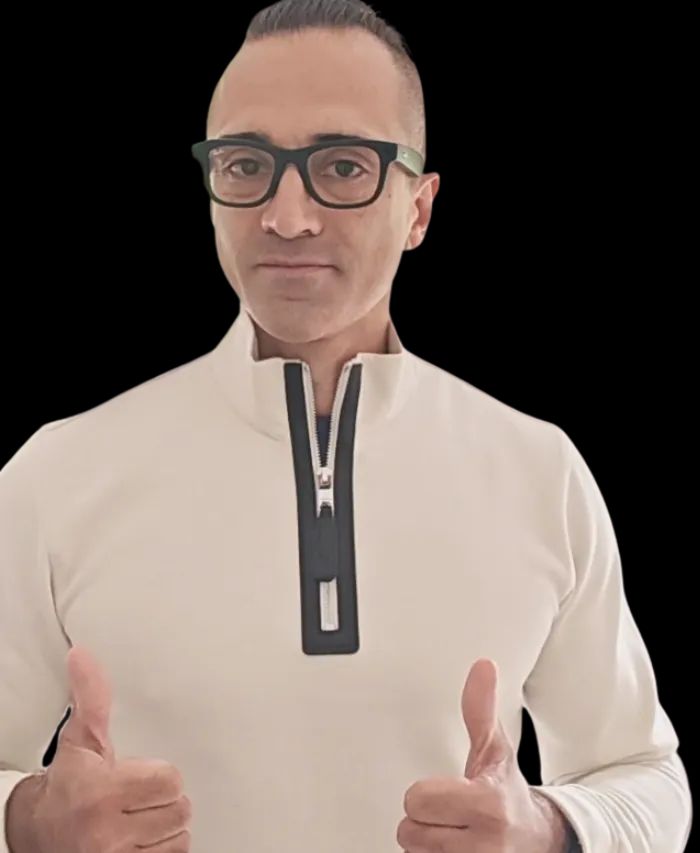
Alex Braganza
Founder, Replicants.ai · 22 August 2026
Sources: ADP, People at Work 2026 (39,000 workers). Frontiers in Psychology, 2026, on algorithmic anxiety. TrustRadius, 2026 B2B Buying Disconnect. SurveyMonkey and Customer Experience Dive on the human premium. The Coach's CMO, State of AI in Coaching 2026.